Two days, four stages, one running order
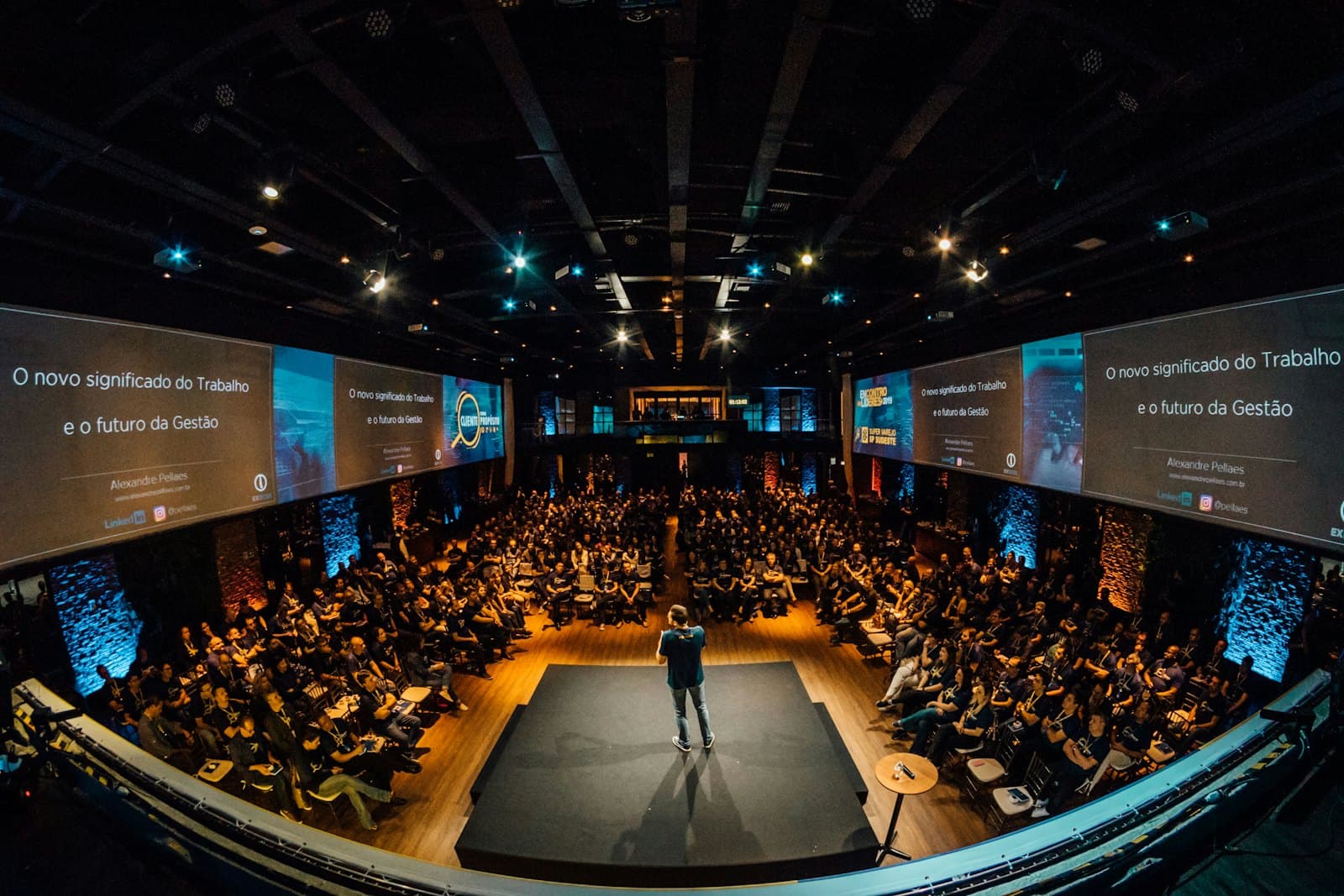
Four stages running in parallel off a single running order, a chairman's address with no margin for error, and a live stream to nine regional offices. Two days, one crew, and a rehearsal in a finished room.
Two days, four stages, one running order
- Format
- Annual conference
- Client
- Private commercial bank
- Venue
- Five star hotel ballroom, Dhaka
- Held
- February 2026
- Attendance
- 1,287 delegates
The day, in order.
Grouped by the part of the day each frame was shot in. Tap any one to open it.
Load-in
We took the hall from six the evening before. Trussing up, LED flown, and the first power test before anyone went home.
Rehearsal
Cue to cue with the real presenters, the real lighting states and the real microphones. This is where the chairman's handover got fixed.
Doors
Registration and badging for 1,200 in under forty minutes, with badges printed on arrival rather than pre-sorted.
The plenary
The opening film, then the chairman, then the strategy session. One stage, 1,200 people, and nine offices watching.
Breakouts
Three stages running in parallel off the same running order, each with its own audio, lighting and LED feed.
The awards
Forty trophies, a live camera cut to the LED, and a closing toast. The segment with the least tolerance for a late change.
What was in scope
A private commercial bank's annual conference, and the largest thing we run in a normal year: two days, four stages, 1,200 delegates in the room and nine regional offices watching a stream that could not fail.
Why four stages is not four times one stage
A single hall with one stage is a production. Four stages sharing one running order is a logistics problem wearing a production's clothes. Every one of them needs its own audio, its own lighting states and its own LED feed, and all four draw from the same power distribution and the same crew. When the plenary overruns by six minutes, three breakout rooms have to absorb it without anyone in them noticing.
So the running order was built backwards from the constraint rather than forwards from the agenda. Each breakout had a hard start and a soft finish, with a five minute buffer that the stage manager could spend or keep. Over two days we spent all of it and finished on time.
The client's technical contact spent two days watching, not fixing. That is the outcome they were paying for, and it is the only one that is hard to put a number on.
The evening before is not optional
We took the hall from six the previous evening. That single line on the quotation is the one most often cut, and it is the reason most conferences feel slightly out of control on the morning of day one.
A rehearsal in a finished room is a different exercise from a rehearsal in a room that is still being built. The lighting states were the real ones. The microphones were the ones the speakers would hold. We ran the chairman's address cue to cue, twice, including the handover to the video that follows it, and found that the lectern microphone and the lapel were both live at the handover point. Fixed in ninety seconds at eight in the evening. On the morning it would have been a feedback howl in front of 1,200 people.
Power, properly
A generator on standby is not redundancy. It is a generator that starts after the lights have already gone out.
Everything ran in parallel with an automatic transfer switch, so a mains failure during the keynote would have been invisible in the room and on the stream. It costs more, nobody quotes it unless asked, and on this show it was the single line we would not negotiate.
The stream was designed first
Nine regional offices meant the remote audience was a fifth of the total, and remote audiences leave when the audio is bad long before they leave when the picture is soft.
The stream took its audio from the sound desk, not from a camera. Graphics were cut in from source through the vision mixer rather than filmed off the projection screen, so a slide read the same on a laptop in Sylhet as it did on the LED in the room. A dedicated line was ordered a fortnight ahead, with a bonded cellular backup that failed over automatically and was never needed.
We also recorded the clean feed locally at full quality, in parallel. That is a disk and a recorder, and it is the reason the recap film exists at all: a platform recording is compressed, usually single-camera, and not something you can cut with.
What our own departments did
The opening film, the award animations, the lower thirds and the presentation templates for all 34 speakers were produced in this building, against the same production schedule as the trussing. That is the argument for consolidating: none of them arrived late from a third party, because there was no third party to be late.
The design studio set the stage graphics knowing what the hall looked like, because they had the same site survey the production team did.
What it produced
Twelve hundred delegates across two days. Nine offices on the stream with no dropout. No slip against the published running order. A recap film cut from the clean feed and delivered the following week, and a delegate feedback summary that the client used to shape next year's agenda.
The same conference is booked again.
Want this run for you?
Tell us the date, the room and the delegate count. You will get a written scope with a costed line against every item, and the questions that change the price.
Or call +880-1711-045500. Replied within one working day.