Eight companies, one corporate story
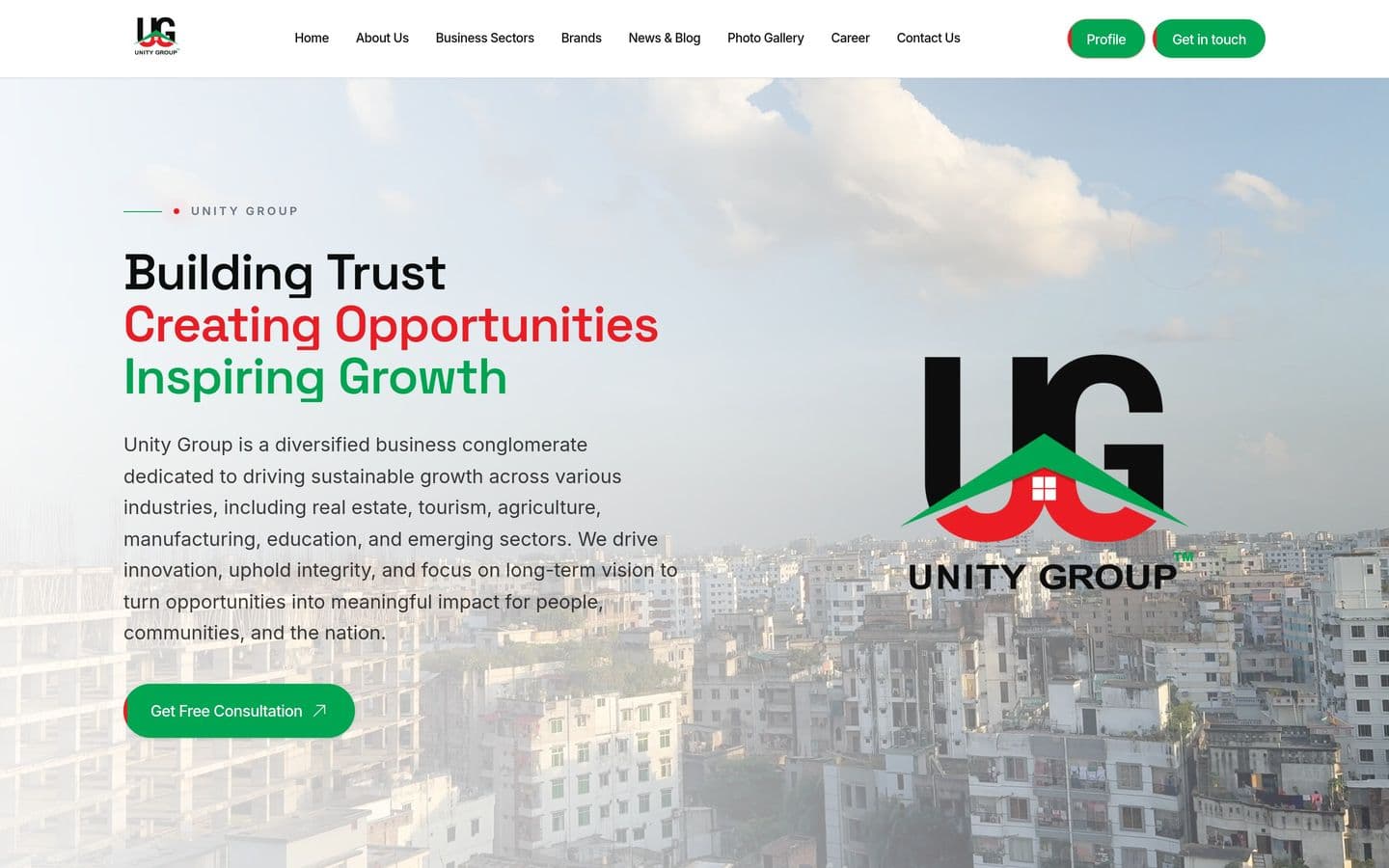
Unity Group operates eight sister concerns across real estate, construction materials, agro, education, tourism and property services. The site had to make one company out of that without flattening what each business actually does.
Eight companies, one corporate story: what we did
1440pxDrag the edge to resize
- Next.js
- React
- Server-side rendering
- Nginx on Ubuntu
- Client-owned hosting
Unity Group is a Bangladeshi conglomerate that has grown by adding companies. Unity Landmark started the group in property. Unity Khati Agro followed in agriculture, then Unity Tourism, then Unity Research and Training Institute and Unity Bricks. Today it runs eight sister concerns across real estate, construction materials, agro, education and training, tourism and hospitality, property management and architectural services.
That growth is the achievement and it was also the problem.
A conglomerate reads as a list unless you build it not to
A group site has to hold two audiences that want opposite things. Somebody arriving from a Unity Bricks invoice wants that one company, quickly, and does not care about tourism. Somebody assessing Unity Group as a partner wants the opposite: the shape of the whole thing, how large it is, how long it has been running, whether the parts are related by strategy or by accident.
Serve only the first and you publish eight brochures stapled together. Serve only the second and every operating company disappears into corporate language about vision and values.
So the structure carries both. Business Sectors is the group view, seven areas of activity described by what they do rather than by which legal entity owns them. Brands is the company view, each sister concern with its own page and its own route in. They are two readings of the same organisation, and which one a visitor takes depends on why they came.
The test we set ourselves: a supplier, a homebuyer, a job applicant and a potential partner should each reach what they came for in two clicks, and none of them should have to understand the group's legal structure to do it.
The figures the site leads with are the group's own and are stated plainly: eight sister concerns, seven business sectors, a workforce above twelve hundred, six core values. A conglomerate that can put those four numbers on a homepage is making a claim a visitor can check, which is worth more than a paragraph about scale.
Templates, because eight companies become twelve
Sectors and brands are content types, not hand-built pages. Each brand has a name, a sector, a description, an image set and a contact route; each sector has a description and the brands inside it. Add Unity's ninth company and it is a content entry, not a development job.
That is not a technical nicety. It is the difference between a site that represents the group today and one that still represents it in three years, which for a company whose entire pattern is adding businesses is the only version worth building.
Written, not filled in
The copy was written rather than collected. A conglomerate site is where corporate language goes to die, and "driving sustainable growth across various industries" tells a reader nothing they could act on. Every sector description says what the business physically does and who it serves. The group's own framing, unity, honesty and responsible growth, stays as the argument the narrative makes, not as three words on a wall.
The journey section does the same job with dates instead of adjectives: Unity Landmark in 2012, Unity Khati Agro in 2015, Unity Group and Unity Tourism in 2016, the Research and Training Institute and Unity Bricks in 2024. A reader can see the pattern and draw their own conclusion, which is more persuasive than being told there is one.
The stack, and why
Next.js with React, server-side rendered, behind nginx on the client's own Ubuntu server.
Server rendering matters here for a specific reason rather than as a default. This is a corporate site whose visitors arrive from search, from a business card, from a WhatsApp forward, often on a mid-range Android on mobile data. A client-rendered site makes those visitors download and execute a bundle before they see a word. Rendering on the server means the page arrives as HTML and reads immediately, and it also means search engines index the sector and brand pages without depending on JavaScript execution.
Hosting on Unity's own infrastructure was a deliberate choice too. The group owns the server, the domain and the repository. Nothing about this site depends on our continued involvement, which is what handover should mean.
What was handed over
The repository, the server access and the domain, plus a written editing guide and a recorded walkthrough of the news, blog, gallery and careers sections. The marketing team publishes without us. We remain on call for changes they would rather not make themselves, which is a different relationship from being the only people who can get in.
Want this run for you?
Tell us the date and the scale and we will tell you what it takes, including the parts a first quotation usually leaves out.
Or call +880-1711-045500. Replied within one working day.